


TL;DR
Herpes blood tests report a numeric index value, not a simple positive or negative. IgG antibodies confirm past HSV-1 or HSV-2 exposure, while IgM tests are unreliable and not recommended by the CDC. Index values between 1.1 and 2.9 carry a high false-positive rate, so a confirmatory Western blot or Biokit test is often needed.
Key Takeaways
- A herpes IgG blood test reports a numeric index value rather than a simple yes-or-no result, and values near the 1.1 cutoff are the least reliable.
- IgM testing for herpes is not type-specific and cross-reacts during recurrent outbreaks, which is why the CDC does not recommend it for HSV diagnosis.
- Low-positive index values between 1.1 and 2.9 have a reported specificity as low as 39.8%, meaning a large share of results in that range turn out to be false positives.
- Confirmatory testing with Western blot or the Biokit HSV-2 rapid test can raise the positive predictive value of a low-index result from roughly 80% to over 95%.
- An index value of 3.5 or higher is far more likely to reflect a true HSV-2 infection than a borderline result close to 1.1.
A herpes test result rarely arrives as a clean “yes” or “no.” Most labs return a decimal number next to the word “positive” or “negative,” something like 1.4, 2.6, or 8.9, and that number is doing real diagnostic work. It reflects how strongly a blood sample reacted against a viral protein in the lab, not a simple presence-or-absence switch.
That distinction matters because not every positive result carries the same weight. A result of 1.2 and a result of 9.4 are both technically “positive” on paper, but they represent very different levels of confidence that a person actually carries HSV-1 or HSV-2 antibodies. Sitting with a low, borderline number without understanding what it means is a common source of unnecessary fear, and it is one of the more frequent points of confusion after routine STI screening.
This guide walks through what IgG and IgM tests actually measure, what the index value represents on an enzyme-linked immunosorbent assay (ELISA), why some widely used tests produce so many false positives at low index values, and when a confirmatory test is worth requesting.

What Do IgG and IgM Results Actually Measure?
IgG and IgM are two different classes of antibody the immune system produces in response to infection. A herpes IgG test looks for type-specific antibodies built against glycoprotein G, a protein on the surface of the virus that differs slightly between HSV-1 and HSV-2. Because gG-1 and gG-2 are distinct enough to be told apart, a properly run IgG test can usually distinguish which type of the virus a person has been exposed to, not just that some herpes antibody is present.
IgM antibodies, by contrast, appear earlier in an immune response and are traditionally associated with “recent” infection. For herpes specifically, this assumption does not hold up well. According to the CDC’s Sexually Transmitted Infections Treatment Guidelines, commercial HSV IgM tests are not type-specific and frequently return positive during recurrent oral or genital outbreaks, not just new ones, which makes them unreliable for telling a first episode apart from a flare-up of an existing infection (CDC STI Treatment Guidelines). For this reason, IgM testing for herpes is not recommended as part of a diagnostic workup. If a lab report includes an IgM result, it generally should not be the basis for a diagnosis on its own.
What Does the Index Value on an ELISA Test Represent?
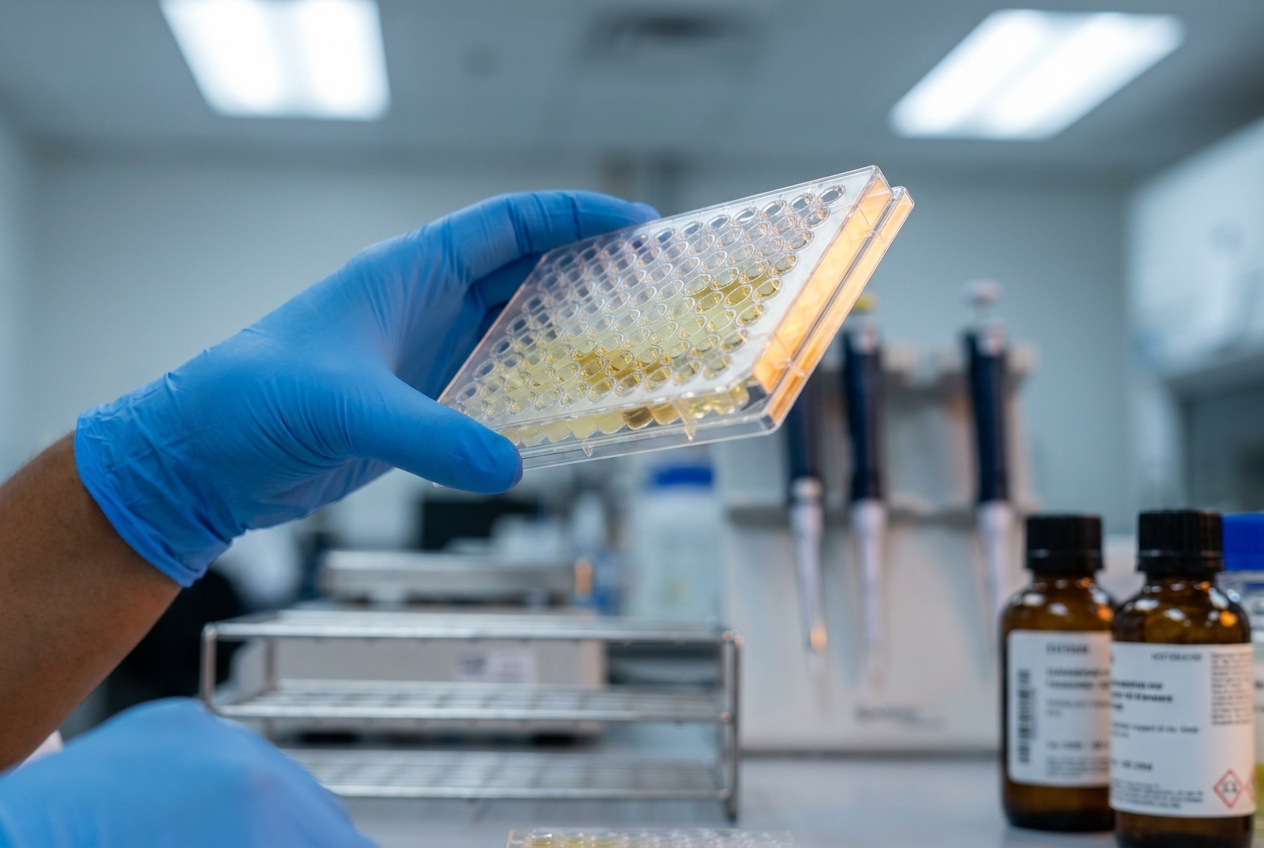
An ELISA-based HSV IgG test does not simply detect antibody as present or absent. It measures how much a sample’s optical density compares to a fixed calibrator value built into the assay, and reports that ratio as the index value. A ratio below the assay’s low cutoff, typically 0.90, is read as negative. A ratio above the assay’s positive cutoff, typically 1.10, is read as positive. Everything in between and just above that line is where interpretation gets complicated.
This matters because the most widely used assay, the HerpeSelect HSV-2 EIA, does not perform evenly across that whole positive range. A 2013 study in The American Journal of the Medical Sciences comparing HerpeSelect against a second rapid test found that agreement between the two assays was strongest at the extremes, index values under 0.90 or at 3.0 and above, while the majority of discordant results clustered in index values between 0.9 and 2.9 (Van Wagoner et al., 2013, doi:10.1097/MAJ.0b013e31826cad3c). A number just over the cutoff is mathematically “positive,” but it sits in the zone where the test itself is least trustworthy.
Why Do Low-Specificity Tests Produce So Many False Positives?
Specificity is the ability of a test to correctly identify people who do not have the condition. A test with 90% specificity still misclassifies 10% of uninfected people as positive, and in a low-prevalence population, those false positives can outnumber true positives among all “positive” results returned.
The CDC guidelines report that the overall specificity of the HerpeSelect assay is around 57.4%, dropping to roughly 39.8% specifically within the 1.1 to 2.9 index range (CDC STI Treatment Guidelines). A study conducted in Kenya and published in the Journal of Virological Methods tested five HSV-2 assays against Western blot as a reference standard and found specificities ranging from 52.3% to 90.9% depending on the brand and generation of the kit, with the lowest-specificity assays also carrying the highest sensitivity (Ng’ayo et al., 2009, doi:10.1016/j.jviromet.2009.10.009). That tradeoff is largely intentional: manufacturers calibrate these assays to minimize missed infections, which pushes up false positives at low index values.
Cross-reactivity is part of the underlying mechanism. HSV-1 and HSV-2 share a large portion of their genome and several structurally similar envelope proteins, so an assay that is not perfectly type-specific can register a weak positive signal from HSV-1 antibody on an HSV-2 test, or vice versa (Bergström & Trybala, 1996, PMID: 9058170). Not every low-positive result is a false positive, but the biological overlap between the two virus types is one of the reasons the test’s precision breaks down near the cutoff.

When Should You Request a Confirmatory Test?
Because of this pattern, a confirmatory test, either Western blot (the traditional reference standard) or the Biokit HSV-2 rapid test used as a second-method check, is worth requesting whenever an initial IgG result falls in the low-positive range. A study published in BMC Infectious Diseases tested 782 serum samples with both HerpeSelect and Biokit, then compared results against Western blot. It found that the positive predictive value of a HerpeSelect result rose from 80.5% to 95.6% once Biokit confirmation was added. Among low-positive index values between 1.1 and 3.5, only 35% were confirmed as truly positive by both Biokit and Western blot, compared with 92% of results with an index above 3.5 (Morrow et al., 2005, doi:10.1186/1471-2334-5-84).
The table below summarizes how index values are typically interpreted, though exact cutoffs vary slightly by manufacturer and lab, so it is worth checking the reference range printed on a specific report.
| Index Value | Typical Interpretation | What the Evidence Shows |
|---|---|---|
| Below 0.90 | Negative | No HSV antibody detected at a level the assay can reliably register |
| 0.90 to 1.09 | Equivocal / borderline | Often re-tested in 2 to 4 weeks rather than acted on immediately |
| 1.10 to 2.90 | Low positive | The range with the lowest reported specificity; confirmatory testing is strongly recommended before treating this as conclusive |
| 2.90 to 3.50 | Positive, worth confirming | Still overlaps with the range where discordant results cluster in comparison studies |
| 3.50 and above | High positive | Around 92% of results in this range were confirmed as true positive in one Biokit/Western blot comparison study |
A confirmatory test is generally most useful for a first-time positive result with a low index value and no prior symptoms, since that is the scenario where a false positive carries the most weight, both medically and emotionally. It is less necessary when an index value is high, when there is a clear clinical history of outbreaks, or when a partner’s known HSV status already makes a positive result unsurprising. A low index value alone is not something to build major decisions around before a clinician weighs in on the full picture, including symptoms, exposure history, and whether a second test method is warranted.

Frequently Asked Questions
What’s the difference between IgG and IgM herpes tests?
IgG tests detect long-term, type-specific antibodies and are considered the standard method for herpes diagnosis. IgM tests detect an earlier antibody response but are not type-specific and are not recommended by the CDC, since they frequently return positive during recurrent outbreaks rather than only new infections.
Can a herpes IgG test tell me if I have HSV-1 or HSV-2?
Yes, when it is a type-specific test built on glycoprotein G. This is different from an older-generation or non-type-specific test, which may only indicate exposure to “herpes simplex virus” broadly without distinguishing between the two types.
Is a low positive index value automatically a false positive?
Not automatically, but it is statistically less reliable. Comparison studies have found that only around a third of low-positive results (roughly 1.1 to 3.5) are confirmed as true positives, which is exactly why confirmatory testing exists for this range.
How long after exposure should I get tested?
Antibody levels take time to build to detectable levels, a process sometimes called the seroconversion window. Testing too soon after a suspected exposure can produce a false negative, so clinicians often recommend waiting several weeks before an initial IgG test and repeating it later if the timing was uncertain.
What is Western blot, and how is it different from Biokit?
Western blot is the traditional reference-standard test, run in specialized reference laboratories and used to resolve uncertain results from more common assays. Biokit is a rapid, easier-to-run test that has been shown to serve a similar confirmatory function for low-positive HerpeSelect results in a routine clinical setting.
Can I trust a home herpes test kit?
Home test kits generally use the same antibody-based methodology as lab-run assays, which means they carry the same limitations around low-index specificity. A result from a home kit that falls in the low-positive range benefits from the same confirmatory follow-up as a lab result.
Summary
A herpes test result is more informative when it is read as a number on a spectrum rather than a flat positive or negative. IgG testing, done well, can identify which type of the virus a person carries, while IgM testing is unreliable enough that the CDC advises against using it for diagnosis at all. The index value on an IgG test reflects how strongly a sample reacted in the assay, and results in the low-positive range, roughly 1.1 to 2.9, carry a meaningfully higher chance of being a false positive than results well above 3.5.
None of this changes what a confirmed HSV diagnosis means for day-to-day life: it remains a manageable, common, and non-dangerous condition for the vast majority of people. Research on the psychosocial impact of a positive HSV-2 diagnosis has found that the emotional weight people carry, fear of disclosure, shame, worry about partners, is often disproportionate to the actual medical severity of the infection, and that those responses tend to ease with time and accurate information (Melville et al., 2003, doi:10.1136/sti.79.4.280). A borderline lab number is worth a conversation with a clinician and, when appropriate, a second test, not a reason to spiral. Some people also look at optional, non-prescription ways to support their immune system generally, such as monolaurin and lysine used together, available through Shop Monolaurin, though these remain complementary options rather than a substitute for accurate testing or antiviral care.

Continue Exploring
- Just Diagnosed and Feeling Overwhelmed: Learning to Breathe Again After HSV-2
- Life After a Herpes Diagnosis: Moving From Shock to Acceptance
- Do Natural Supplements Help Manage Herpes?
References
- Van Wagoner, N.J. et al., “Serologic screening for herpes simplex virus type 2 in persons with human immunodeficiency virus,” The American Journal of the Medical Sciences, 2013. https://doi.org/10.1097/MAJ.0b013e31826cad3c
- Morrow, R.A. et al., “Use of ‘biokit HSV-2 Rapid Assay’ to improve the positive predictive value of Focus HerpeSelect HSV-2 ELISA,” BMC Infectious Diseases, 2005. https://doi.org/10.1186/1471-2334-5-84
- Ng’ayo, M.O. et al., “Performance of HSV-2 type specific serological tests in men in Kenya,” Journal of Virological Methods, 2009. https://doi.org/10.1016/j.jviromet.2009.10.009
- Whittington, W.L. et al., “Use of a glycoprotein G-based type-specific assay to detect antibodies to herpes simplex virus type 2 among persons attending sexually transmitted disease clinics,” Sexually Transmitted Diseases, 2001. https://doi.org/10.1097/00007435-200102000-00007
- Bergström, T. & Trybala, E., “Antigenic differences between HSV-1 and HSV-2 glycoproteins and their importance for type-specific serology,” Intervirology, 1996. https://pubmed.ncbi.nlm.nih.gov/9058170/
- Melville, J. et al., “Psychosocial impact of serological diagnosis of herpes simplex virus type 2: a qualitative assessment,” Sexually Transmitted Infections, 2003. https://doi.org/10.1136/sti.79.4.280
- Centers for Disease Control and Prevention, “Herpes — STI Treatment Guidelines.” https://www.cdc.gov/std/treatment-guidelines/herpes.htm